The “seeing power” of Sky Islands: Coronado
Past, present, and future visions for Coronado National Memorial as Sky Island
the history hikes
Past, present, and future visions for Coronado National Memorial as Sky Island
the history hikes
September 21, 2026
One of Coronado’s first champions was Grace Sparkes. A mining woman with mines always on the mind, Grace has a somewhat problematic, complicated history. But so many of the people connected to these places do…
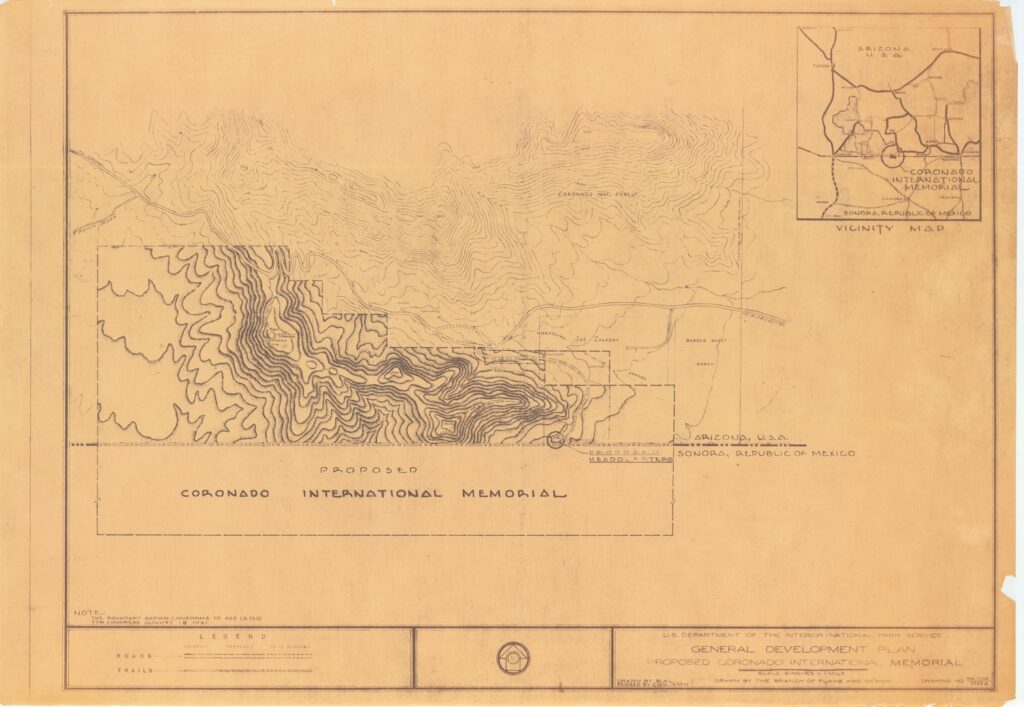
And yet, she is the one that tracked down the original map proposal of the binational park from Congress and the National Archives—and was relentless in doing so. Even after so many told her no, she used her own name (revolutionary in that time), as a widow, to get what she wanted.
Grace had a vision for Coronado and, as long as that vision did not impact her own mining claims in the area, she was determined to see Coronado project through until its end.
In this hike, we explore a little more about Grace’s vision (for her full feature, see this hike!), other visions of the area across time and space, as well as the past, present, and future visions for the Arizona-Sonora Sky Islands and Coronado as a binational park for the people, history, culture, and rich biodiversity.
In 1946, long after the dream for an International Coronado Monument had seemed to stall out, Grace wrote to Sir Hillory A. Tolson, then the Acting Director for the US Department of the Interior to suggest a revival of the project.
In a cheeky yet convincing tone, Grace highlights the “magnificent beauty” of the region. Coronado is a “wonderland,” she writes.
“Picturesque, rugged and to a certain extent wild.”
Particularly, she highlights the view:
“Certainly one of the most unusual and stimulating views to be had is that from the Lookout Point on the Coronado International Memorial. Several of our Prescott friends—world travellers—have visited us recently and they were most enthusiastic in their declarations that this view is the finest they have had in their travels.”
As post script, written as though she actually standing from atop the “Lookout Point” at Coronado (and maybe she was!),Grace Sparkes declared:
“Certainly this could be made one of the greatest points of interest in our Borderland. I have been living these hills for over a year. Climatically it is superb….from the standpoint of flora and fauna—unsurpassed and for those who enjoy Nature I do not know of a more interesting and enlightening area.
“We saw a magnificent display of the meteors on two nights. According to our beloved Sharlot Hall, Arizona’s poet laureate and historian this area had the greatest “seeing power” for the stars of any area in our Southwest. Since starting this I just returned from taking some folks to see the Summit and its marvelous view. We have been gone from Camp four hours.
“So it goes – here’s hoping this will stirup some enthusiasm and interest anew.”
GMS
Grace had her own problematic ties to mining and a family legacy of land extraction. She held tightly onto her mining claims (now a bat cave within Coronado)—almost as tightly as she held onto racist and romanticized views of Western culture and Indigenous Peoples. We explore more about Grace and her history in the hike, “the formidable (and problematic!) Grace Sparkes”—but this quote she gives us is true.
Coronado offers one of the most amazing views—not just of the park, but through the borderlands, across the Sky Islands, and into the connectivity across the Americas. There is a certain “seeing power” that the Summit affords us, and it is just the physical view. From Coronado Peak (once also known as Montezuma Peak) we humans can also contemplate the crossing and convergence of history (human and ecological) and science, and the relationships between these concepts (and more!).
Seeing this park as one of the connected yet isolated mountains that form the Arizona-Sonora Sky Islands changes the story—or at least alters our (quite literal) perspective.
To get some clues about all that we can “see” from Coronado Peak—and the extent of this potential park’s “seeing power”—in this hike, I stop for some moments to rest up and gather inspiration from scientists, artists, authors, activists, and more who tell us (and show us!) what it is they “see” from one of the most “unusual” and thought-provoking views from across the Americas.
Add More Coronado Hikes list