
Crazy quail, Montezuma quail, Mearns quail, Massena quail, Harlequin quail, Moctezuma Quail, zolin and more —- all different names for the same remarkable bird, notable for its striking plumage. It will be referred to as the Montezuma quail for the purposes of this article, but it is important to recognise that the other various terms for the Montezuma quail are not antiquated; they represent a rich history of cultural intersections which still persist to the current day.
Zolin is perhaps the oldest name for the Montezuma quail. It is the bird’s given name in Nahuatl, the language spoken by many native Mesoamerican groups such as the Mexica. Montezuma itself is a name derived from Motecuhzoma II, sovereign of the Aztec peoples from 1502–1520. He was viewed by his people as a representation and impersonation of the sun god Xiuhtecuhtli. The Montezuma quail itself symbolized the starry night and the moon to the Mexicas, likely in conjunction with its white-and-black bespeckled plumage. It was often used in sacrifice before the dawn of day, and it was the only food given to the Aztec’s eagles, which were conversely seen as symbols of the sun. Though bestowed by the Spaniards upon this bird, the name Montezuma can thus be likewise seen as representative of its rich cultural history.
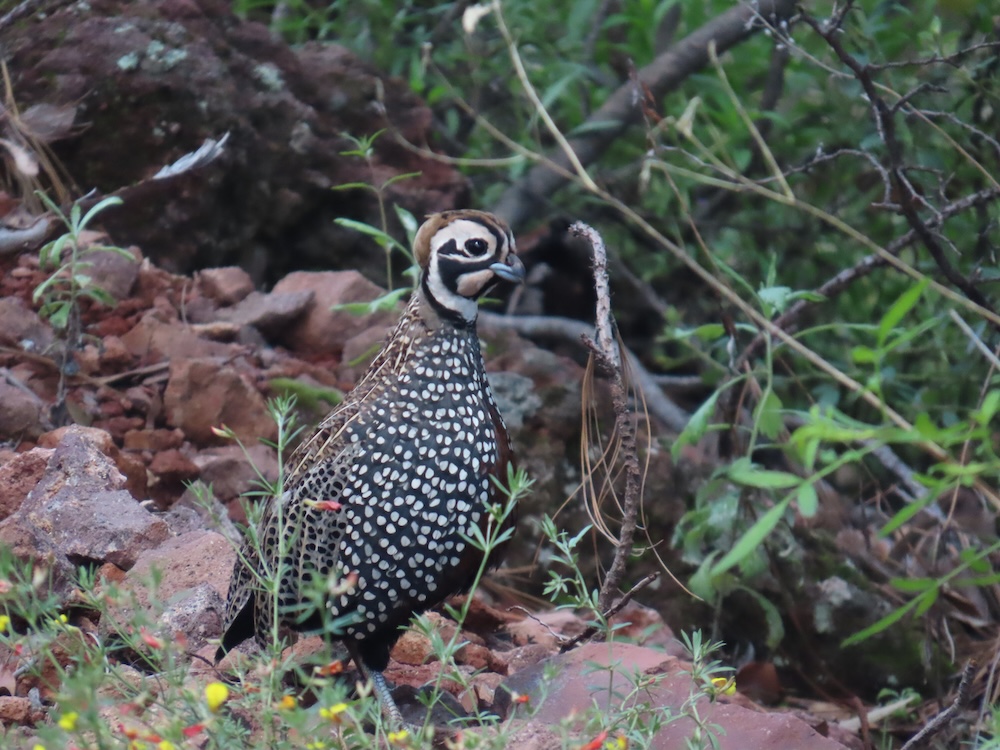
In recent years, however, the Montezuma quail appears to be at risk. Though the bird is considered to have a relatively large population compared to historical record, it is currently listed by SONAB (the State of North American Birds) as a Watch List species due to continued population declines and losses of their native habitats. Preservation of the Montezuma quail relies centrally upon preservation of its native grassland and especially its Madrean woodland habitats, which spread throughout Mexico and its bordering states. The project of Montezuma quail preservation seeks to benefit not only itself but also the hundreds of species endemic to the region, many of which likewise threatened due to the loss of nearly 80% of their native habitat.
Due to this broad reaching habitat of woodlands and grasslands which frequently span into private ranches along Texas, Arizona, New Mexico and the Mexican Plateau, quail documentation and preservation efforts necessitate communication and interconnection with land owners across the Southwestern United States. These individuals are often wary of permitting scientists to access their lands and record quail sightings, particularly due to lack of familiarity with typical conservation practices. On the more commercial side, the National Audubon Society has been pioneering these outreach efforts with their Conservation Ranching Project, which habitually surveys consenting ranch owner’s properties and applies a Certified Bird-Friendly label to their products if their lands are deemed suitable to native species. With consumers reacting very positively to the label, this system has seen great success since its 2017 beginning. Nationwide, 157 ranches and farms spanning more than 4.5 million square acres participate in the program. This is of course a great step in the restoration of at-risk bird species nationwide, including the Montezuma quail.
However, if conservation efforts of this species are successful, researchers must continue to further science outreach and open communication practices beyond commercial efforts. The Montezuma quail’s native range is estimated to be more than 400 million acres squared, spanning across states and directly through the border into Mexico. Because of this intersection across borders, research and conservation efforts need to collaborate binationally in order to ensure the success of this notable bird and its ecosystem more broadly. Several recent and promising programs have been established to this aim.
For instance, the binational programs Sonoran Joint Venture, Borderlands Restoration Network, and Quail Forever have recently partnered to restore broad ranges of Montezuma quail habitat and implement monitoring systems in Arizona through a combination of direct oak-woodland and grassland restoration, volunteer networking, and landowner education programs. The Montezuma quail is also directly featured in the Sky Island Alliance’s Border Wildlife Study, in which the presence and interactions of wildlife is monitored around both the unwalled and walled sections of border between the US and Mexico. This enables a much greater understanding regarding the impacts of such distinct habitat fragmentation on the Montezuma quail and the overall ecosystem. Through the collaboration of universities in Sonora, Mexico and the US Fish and Wildlife Association, compilations of Montezuma quail genetic diversity information have also been made possible. The conjunction of these studies has helped to determine the population isolation which occurs across borders and the necessity for solutions such as animal wildlife passages within the border wall. Therein, we can understand the preservation of the Montezuma quail and its habitat as not a story of preserving one isolate species. It is rather one of preserving and fostering connections between historical cultures, between ecosystem communities, and between modern-day peoples.
Side-trekking (further reading list)
Montezuma Quail Cultural Importance:
Information regarding Motechuzoma II’s reign and the cultural roles of religion within Aztec society: Baquedano, E., & Berdan, F. F. (2025). Aztec sovereignty and Motecuhzoma Xocoyotzin’s sacred and secular roles. World Art, 15(1), 95–121. https://doi.org/10.1080/21500894.2025.2459848
Quail symbolisms and related ritual practices within the Nahua culture: Mazzetto, E. “Quail in the Religious Life of the Ancient Nahuas”, en Milbrath, Susan y Elizabeth Baquedano (coords.), 2023, Birds and Beasts of Ancient Mesoamerica. Animal Symbolism in the Postclassic Period, Denver, University Press of Colorado, pp. 200-219.
Zolin Glyph and Related Context: Stephanie Wood. Zolin (Mdz48r) | visual lexicon of aztec hieroglyphs. Visual Lexicon of Aztec Hieroglyphs. https://aztecglyphs.wired-humanities.org/content/zolin-mdz48r
Montezuma Quail Ecosystem and Conservation Efforts:
Montezuma quail documentation efforts in conjunction with landowner communication practices: Holdermann, D. (2008). Montezuma Quail, A Government Biologist, And Trans-Pecos Ranchers: The Nature of Our Relationship. 9–17. Proceedings of the Trans‐Pecos Wildlife Conference‐2008. Sul Ross State University, Alpine, Texas.
US Fish and Wildlife Service Official Status of Montezuma Quail and Conservation Efforts: Enhancing Habitat for Montezuma Quail | U.S. Fish & Wildlife Service. (2022, May 10). FWS.Gov. https://www.fws.gov/project/enhancing-habitat-montezuma-quail
Study Describing Montezuma Quail Vulnerabilities to Habitat Loss (tall-grass cover requirements): Albers, Randy P., and Frederick R. Gehlbach. “Choices of Feeding Habitat by Relict Montezuma Quail in Central Texas.” Wilson Bulletin Vol. 102.No. 2 Jun., 1990. 300-308. JSTOR. Web. 3 Dec 2013. http://www.jstor.org/stable/4162867.
Avian Conservation Assessment Database offical Montezuma Quail Status (Yellow Watch List, as of 2024): Partners in Flight. 2024. Avian Conservation Assessment Database, version 2024. Available at http://pif.birdconservancy.org/ACAD.
Overview of Texas-based Conservation Efforts for the Montezuma Quail and Related Species
Wunderlich, E. (2026). Two elusive quail species are in trouble. What’s behind the quiet quail crises? Texas Parks & Wildlife Magazine. https://tpwmagazine.com/wildlife-conservation/two-elusive-quail-species-are-in-trouble-whats-behind-the-quiet-quail-crises/
Collaborative Paper Detailing Lack of Genetic Variations of Montezuma Quail Population Islands
Sánchez-Murrieta, E., Macías-Duarte, A., Castillo-Gámez, R. A., Varela-Romero, A., Montoya, A. B., Weaver, J. H., and Pacheco-Hoyos, N. G. (2023). Genetic variability and population structure of the montezuma quail (cyrtonyx montezumae) in the northern limit of its distribution. PeerJ, 11, e16585. https://doi.org/10.7717/peerj.16585
Information Regarding the Madrean Pine-Oak Woodland Ecosystem, a Critical Montezuma Quail Habitat:
Critical Ecosystem Partnership Fund (2019). Madrean pine-oak woodlands – species | CEPF. (2019). Cepf.Net. https://www.cepf.net/our-work/biodiversity-hotspots/madrean-pine-oak-woodlands/species